

Í MINNINGU EBRU TIMTIK – IN THE MEMORY OF EBRU TIMTIK
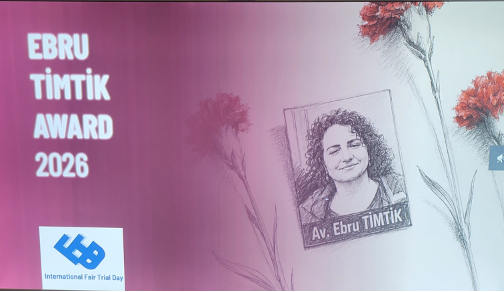
Í gær stóðu samtök lögmanna og mannréttindasamtök fyrir “degi sanngjarna réttarhalda”, „fair trial day“ í Búdapest í Ungverjalandi. Verðlaunin eru veitt í minningu kúrdísku/tyrknesku baráttukonunnar Ebru Timtik. Þau eru veitt árlega og í fyrra voru þau veitt í Túnis. Að þessu sinni varð Ungverjaland fyrir valinu.
Ebru Timtik lét líf sitt á baráttu fyrir mannréttindum í Tyrklandi. Hún hóf mótmælasvelti í fangelsi í byrjun árs 2020 og lést í ágústlok á því ári. Hún hafði þá setið í fangelsi í þrjú ár en árið 2017 höfðu 18 lögmenn verið fangelsaðir í einni af mörgum ofsóknarhrinum stjórnvalda á hendur baráttufólks fyrir mannréttindum. Allir áttu þessir lögmenn það sameiginlegat að hafa varið einstaklinga sem gagnrýnt höfðu stjórnvöld. Í kjölfar dauða Ebru Tintiks sameinuðust lögmannasamtök og mannréttindahópar um að stofna til verðlauna í minningu hennar og skyldu verðlaunin ganga til þeirra sem hefðu beitt sér í hennar anda; aldrei í eigin þágu, eingöngu í þágu þeirra sem stæðu höllum fæti og sættu kúgun.
Ég var í dómnefnd sem valdi verðlaunahafann úr hópi nokkurra aðila sem höfðu verið tilnefndir.
Nefndin komst að þeirri niðurstöðu að veita meþódistaprestinum Gábor Iványi verðlaunin en hann hefur um langt árabil beitt sér í þágu þeirra hópa sem helst standa utangarðs í Ungverjalandi. Fyrir vikið hefur hann sjálfur verið ofsóttur. Í niðurstöðu dómnefndar segir m.a. á ensku:
“The distinctive character of Gábor Iványi’s struggle lies in the fact that it has unfolded on two inseparable levels. On the one hand, for many years he has built concrete networks of solidarity in Hungary for the poor, the homeless, Roma communities, refugees, children, persons with disabilities, and socially excluded groups … On the other hand, precisely because of these activities, Iványi and the institutions under his leadership have themselves become targets of political, administrative, financial, and ultimately criminal pressure… “
Á ráðstefnu sem efnt var til í tilefni verðlaunafhendingarinnar flutti ég ræðu sem ég birti hér að neðan auk greinargerðar dómnefndarinnar. Ráðstefnuna sóttu fulltrúar Mannréttindastofnunar Sameinuðu þjóðanna og annarra alþjóðastofnana auk lögmannasamstaka, mannréttindahópa. Þarna voru lika fulltrúar réttarkerfisins í Ungverjalandi og Evrópusambandsins.
Below is the Reasoned Decision of the Jury:
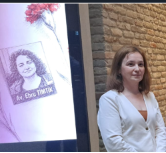
Það var Bernadette Somody, háskólaprófessor í lögum í Búdapest sem kynnti niðurstöðu dómnefndarinnar:
International Fair Trial Day – Ebru Timtik Award
Reasoned Decision of the Jury on the Selection of Gábor Iványi
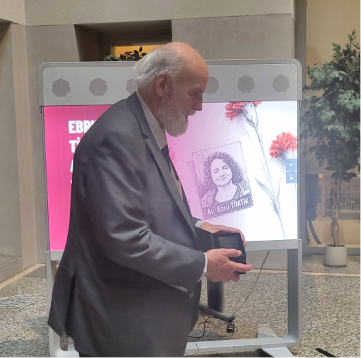
As the Jury of the International Fair Trial Day – Ebru Timtik Award, composed of Bernadette Somody from Hungary, Lamine Benghazi from Tunisia, Latife Akyüz from Türkiye, Kristina Conti from the Philippines, and Ögmundur Jonasson from Iceland, we accepted this responsibility with great honour, appreciation, and a deep sense of accountability.
We would first like to express our gratitude to the legal organisations and human rights institutions that, in the aftermath of Ebru Timtik’s loss, came together to establish and sustain such an important international initiative. We regard this effort not only as a tribute to her memory, but also as a meaningful act of transforming grief into struggle, loss into solidarity, and remembrance into a living commitment to justice. The fact that Ebru Timtik’s name continues to bring together lawyers, human rights defenders, and organisations from different countries is, in itself, a powerful continuation of the struggle for the right to a fair trial.
The Jury carefully, respectfully, and with a deep sense of responsibility examined all nominations submitted for the Award and we. wish to underline at the outset that each nomination submitted was highly deserving of recognition.
Before reaching its decision, the Jury considered carefully how the criteria of the Ebru Timtik Award should be interpreted. We welcomed the fact that the guidelines invite a broad understanding of work related to the right to a fair trial. Such an approach is essential. The right to a fair trial cannot be reduced to a narrow question of criminal procedure, nor can it be confined to the walls of the courtroom. It is inseparable from the rule of law, judicial independence, the right of defence, non-discrimination, access to justice, freedom of expression, and protection against arbitrary state power.
In this broader sense, the right to a fair trial is not only a guarantee for those already standing before a court. It is also a safeguard for those who are rendered unequal before the law, deprived of effective remedies, excluded from public resources, or punished for defending the dignity of others. It protects not only the accused, but also the lawyer, the human rights defender, the social worker, the dissident, the minority community, the poor, the refugee, the Roma person, the LGBTI+ person, the child, the person with disabilities, and all those whose lives are made vulnerable by the combined force of state power and social exclusion.
The Jury also considered that the Ebru Timtik Award carries a particular moral and political responsibility. An award bearing Ebru Timtik’s name must not be directed merely to abstract declarations concerning the right to a fair trial. It must also recognise those who defend this right while paying a price for doing so. Ebru Timtik made the demand for a fair trial visible at the cost of her own life and became one of the symbols of the right of defence, judicial independence in political trials, and resistance against the instrumentalisation of law. For this reason, the Jury understood the Award as a form of international solidarity with those who defend justice while themselves being exposed to injustice.
It is within this framework that the Jury decided to confer this year’s International Fair Trial Day – Ebru Timtik Award on Gábor Iványi.
This decision is not only an acknowledgment of Iványi’s decades-long commitment to human rights and social justice. It is also a statement that the right to a fair trial is a fundamental right that protects human dignity against state power, particularly for individuals and communities pushed to the margins of society. Iványi’s life and struggle correspond in a powerful way to the broad understanding of the Award’s criteria. His work demonstrates that the defence of the right to a fair trial is inseparable from the defence of the poor, the homeless, Roma communities, refugees, children, persons with disabilities, LGBTI+ persons, faith communities, and all those subjected to discrimination and exclusion.
The distinctive character of Gábor Iványi’s struggle lies in the fact that it has unfolded on two inseparable levels. On the one hand, for many years he has built concrete networks of solidarity in Hungary for the poor, the homeless, Roma communities, refugees, children, persons with disabilities, and socially excluded groups. Through shelter, education, food assistance, and social services, he and the institutions he has led have reached people whom the state has neglected, abandoned, or deliberately excluded. His work has never remained at the level of symbolic advocacy; it has created material, everyday, life-sustaining forms of solidarity.
On the other hand, precisely because of these activities, Iványi and the institutions under his leadership have themselves become targets of political, administrative, financial, and ultimately criminal pressure. In this respect, Iványi is not only a defender of rights; he has also become a direct subject of rights violations arising from the very principles he has defended. His case therefore brings together the two dimensions that are central to the spirit of the Ebru Timtik Award: the defence of others against injustice and the personal exposure of the defender to state retaliation.
One of the principal reasons why the Jury came to its decision to confer the Ebru Timtik Award on Iványi is his uninterrupted and non-selective position on the side of the oppressed. His struggle has never been confined to a single identity, a single social group, or a temporary political conjuncture. He has maintained the same ethical stance in the struggle of Roma communities for equal citizenship, in the struggle of LGBTI+ persons for visibility and dignity, in the protection of refugees against dehumanising exclusionary policies, in the access of the poor and the homeless to basic rights, and in the defence of freedom of expression and democratic space. This line reminds us that human rights advocacy cannot be selective; it must be universal. It also reminds us that solidarity itself must be guided by the same principle.
The Jury was also attentive to the fact that, among highly valuable institutional and collective nominees, Gábor Iványi’s candidacy concerned a person who faced direct criminal pressure. This distinction did not diminish the importance of the other nominees; on the contrary, the Jury recognises the indispensable role of institutions, legal teams, and collective structures in sustaining the struggle for justice. However, in the specific context of this Award, the fact that Iványi is a person whose name, body, history, and public presence have become the target of state pressure gave his candidacy a particular urgency. Awarding him brings visibility not only to a field of work, but also to a human rights defender who personally bears the consequences of that work.
In this respect, Iványi’s struggle deeply intersects with the struggle of Ebru Timtik. Although he comes from a different country and a different cultural and intellectual tradition, he stands on the same fundamental ground: the defence of human dignity against the punitive, exclusionary, and arbitrary power of the state. Their struggles might have different forms, but deeply connected in substance.
The convergence of these two struggles, both carried out without personal interest and at great personal cost, was of particular significance for the Jury. The Jury was profoundly moved by the way in which differences in geography, culture, belief, and background came together in a shared struggle for justice. This convergence embodies one of the most important meanings of the International Fair Trial Day: the recognition that the demand for justice travels across borders, languages, legal systems, and political contexts.
The pressures Iványi has faced for years are therefore of central importance. The criminal proceedings against him do not concern only the prosecution of one individual. They also reveal the broader danger of criminalising institutions of social solidarity, independent faith communities, civil structures working for the poor, and human rights defenders who criticise government policies. Bringing international visibility to this criminal process will strengthen not only the symbolic value of the Award, but also its protective and solidarity-based function.
The Jury also considered with special attention the advisory opinion submitted by Barkın Timtik. As emphasised in that opinion, while all nominees were worthy of an Award bearing Ebru Timtik’s name, the fact that Iványi has been declared “undesirable” by different regimes since the 1980s, together with the urgent need to make visible the criminal proceedings he currently faces, gave particular strength to his candidacy. This continuity demonstrates that Iványi’s struggle cannot be explained by personal, temporary, or political interest. On the contrary, it reflects a consistent commitment grounded in conscience, ethics, and rights.
Awarding Gábor Iványi also sends a strong international message against the shrinking of civic space, the weakening of judicial guarantees, the pressure placed on independent institutions, and the spread of discriminatory policies not only in Hungary, but also across Europe, irrespective of electoral outcomes. This message is addressed not only to Iványi himself, but also to those who work with him, to the poor, Roma communities, refugees, children, persons with disabilities, LGBTI+ persons, and all those engaged in the struggle for rights who benefit from the institutions and networks he has helped sustain. The Award affirms that they are not alone and that the right to a fair trial is directly connected to the lives of the most vulnerable members of society.
For all these reasons, the Jury has concluded that Gábor Iványi represents the spirit of the International Fair Trial Day – Ebru Timtik Award in a powerful, meaningful, and timely manner. His life demonstrates that the right to a fair trial is inseparable from the struggle against poverty and discrimination, from freedom of expression, democracy, solidarity among peoples, and the defence of human dignity. Granting this Award to him will make a significant contribution both to the struggle for rights in Hungary and to the international legacy of solidarity carried by Ebru Timtik’s name.
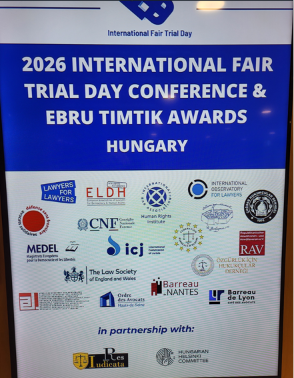
Ræða mín á ráðstefnunni, my speech at the conference:
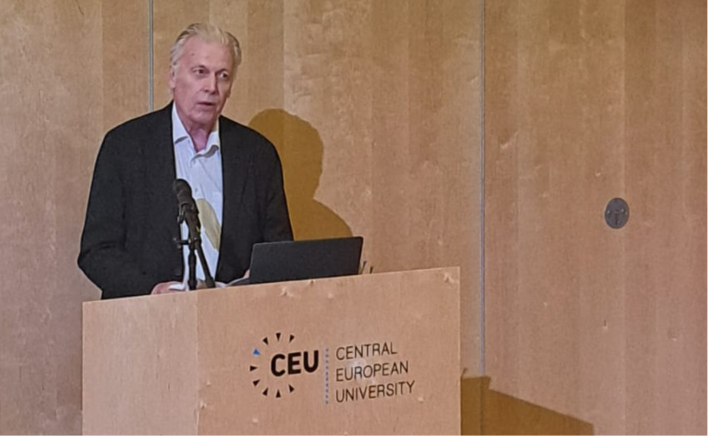
At the outset I would like to tell you why it is that I think the Ebru Timtik Award is of value - and great value at that – not only for the legacy of Ebru Tintic and not only for the recipient of an award in her name, but for society at large.
This is because the award has a message – or rather, is meant to be a message – a message to those in power, a message to society; a message to all of us.
It is a message about the importance of guarding human rights, guarding those who are being subjected to injustice and it is also about guarding the guardians of human rights, not in any abstract terms but real terms, real people, people who are being oppressed, people who are unable to defend themselves, but also those who stand up against unjust power as did Ebru Timtik who had to pay with her life in a Turkish prison.
The institutional world of justice took that with silence and Ebru´s friend wrote: “After Ebru’s death, I have difficulty in making proper sentences. My voice trembles as I speak of United Nations principles, Human Rights Conventions, ECHR (European Court of Human Rights) or other legal applications. I just want to shout, Ebru died of hunger, for the right to a fair trial!”
The Ebru Timtik Award is a wake-up call for the international system of justice, an effort to gather forces for establishing and strengthening the rule of law both locally and internationally; and it can also be seen as a contribution to a collective effort to cultivate justice in society at large – cultivate justice in our hearts.
And much is at stake. The institutional law-based order that came into being in the twentieth century is giving way to an order where power dictates, not the rule of law, much less the rule of justice.
In many states and also internationally we are moving dangerously close to a fascist mentality. News of tens of thousands of political prisoners in Turkish prisons does not come as a surprise but when the political leadership of the European Union – not the EU Court of Justice but the Council of Ministers - decides to deprive the military analyst Jacques Baud, of the right to express his views, critical of EU foreign policy, it becomes obvious that danger is looming. The same applies to others, I name the German citizen, Hüseyin Dogru, as another victim of censorship having been deprived of basic rights to existence. There are others. In this country, Hungary, I have learned, there are many instances of people being imprisoned without a fair trial for opposing authoritarian methods. Now we wait to see their fate unfold under a new regime. But while we wait, our eyes should be wide open and continued injustice should not be taken with silence. Being silent is being complacent.
Some states are worse than others in this sense but it is important to recognize that fundamental changes for the worse are taking place in all too many societies in this part of the world.
How has this come about?
Here a little prologue is needed to give some outlines to the historical context we find ourselves in; and to be taken note of, war and peace, justice and injustice, freedom and the lack of freedom, are all in some way interconnected.
This is how I see it from my perspective, coming from a western generation born in the wake of WWII: We were staunch believers in progress, optimism was prevailing amongst us, as was indeed the spirit within the walls of the newly established United Nations with its Charter of human rights. Steps had been taken to overcome the weaknesses of the League of Nations with structural changes that gave a war-torn world hope for a more peaceful future.
As far back as the 17th century, following the hecatomb - the horrendous offering of human lives, of the 30 Years’ War - Europeans had built a modus vivendi, imperfect as it may have been, upon the Peace of Westphalia of 1648. And now in the 20th century there was reason for real hope of a new start, based on the UN Charter, promising to become a new world constitution. The International Court of Justice, again - at least in the eyes of the optimistic - was seen as a universal constitutional court in the making but as yet lacking the means to enforce judgments and advisory opinions. This would come with time it was thought.
Further weaknesses were still to emerge in the lack of enforcement capabilities but nevertheless it can be said that in this epoch there was optimism that a peaceful world could be built on the basis of mutual respect and mutually beneficial commerce. In Europe in particular, the European Convention on Human Rights and the European Court of Human Rights held much promise.
The oil crises of the mid-70s had not hit when I entered university in Britain in 1969.
With job prospects abounding in the fast-growing economies of the post-war years, I decided to allow myself the luxury of becoming a generalist. With due respect for specialization in biology and engineering I opted for history, philosophy and politics, seeking the cultural dimension in life; a dimension edifying for the individual and enriching for society in general. But whether the world would perish without specialized expert knowledge of our historical heritage was another matter.
After all, a world which was steadfastly heading in the right direction could not fail – with or without knowledge of the past - and if our world got derailed, it could be put on the right track again by democratic pressure. Such was the spirit.
Thus in the 1980s when preparation for massive nuclear armament was underway in Europe the masses took to the streets with their demands for disarmament thus preparing the ground for the INF treaty (the Treaty on Intermediate-Range Nuclear Forces) whereby armament plans were not only shelved but thousands of nuclear warheads destroyed. The protests were in the West, but they also shook the foundations of the Soviet block which soon were to crumble.
And when the disintegration of the Soviet block was decided on and likewise the dissolution of the Warsaw Pact this was seen by many as an opening for peaceful co-existence based on agreements and handshakes in the highest seats of power in East and West alike.
But as is common knowledge, all such handshakes and promises were broken as NATO moved eastwards and weaponised, Russia then invaded Ukraine, the Middle East was set ablaze; and in Europe a “war mode” for the economies was called for in the Council of Ministers of the European Union in 2024. The INF, nuclear disarmament treaty, had by then of course been scrapped and entered on the world stage had an Emperor who would not have been bothered by H. C. Andersens´ little child from his fable, famously saying that the Emperor was without clothes.
The current President of the United States is not bothered by transparency. You might say he was inclined to political nudism. Everything, the good and the bad, should be on show. But then there is in his mind no distinction to be made between the good and the bad. It is power and only power that is to be reckoned with.
We have entered a new era, a new mentality; a mentality which is found in the savanna and the jungle.
Now it is Davos, created by the moneyed interests of the world, that attracts the attention of the world press rather than the United Nations. It hardly makes the news when judges of the International Criminal Court or Independent Experts of the UN are threatened and ostracized by those who hold the reins of power in the world.
And in the same vein it hardly comes as a surprise when we now get the news that The International Award of the Peace of Westphalia a prize intended to honour outstanding contributions to international understanding and sustainable peace, thus reminding us of 1648, is to be awarded to a militarist organization; in other words, this year the Friedenspreis von Westfalen goes to NATO. The message is clear from those awarding the prize, only military power, weapons, can make us secure in the face of an enemy waiting to harm us.
Where have we come to? We reach for Hemmingway´s Farewell to Arms, where he reminded us that a war is not won by weapons, nor even by victory; winning wars requires an altogether different process,
And again we reach for the bookshelf to find Stephan Zweig´s De Welt von gestern, where he explains how in the inter-war years of the 20th century the militarization of entire societies took place, the precondition having been the militarization of the mind; a massive manipulation of people through propaganda where every single citizen in one country was to hate every single citizen in another country, where entire nations where to hate entire nations. And so it became, Germans hated the French, the French the Germans, the British also hated and were hated in return. And then we had a devasting war, a hecatomb once more.
I have now changed my views. Specialized knowledge of history and philosophy should not be regarded as a luxury for the generalist; knowledge of our historical heritage should even be regarded as the most important field to become specialised in. If we are to understand how to grapple with the problems of the world we must understand how manipulation of people takes place, by stirring in the melting-pot of the past.
Everybody, individuals, groups and nations, share collective passed memories. Some are good some are burdensome and the latter in particular must be understood. If you are to solve wars in the Middle East you must understand the history of the Jews and you must fully understand the history of Palestinians driven from their land and then subjected to apartheid rule, you must understand feelings in the Baltic states which were under the heel of Moscow and you must understand the memories from Leningrad – now Petersburg – where a million and a half lost their lives under a Nazi siege during WWII. A Hungarian friend of mine explained anti-muslim sentiments to be found in his country by reference to slavery during the Ottoman Empire, where girls from these parts and southwards were forced into harems and boys conscripted to lose their lives in the army of a Sultan somewhere in the far distance. None of this is an excuse for anything done to people in our times but one must understand that these are the big melting pots which leaders of dictatorial tendencies use to stir up collective memories, collective animosity and hatred. When five thousand German soldiers arrive near Petersburg as is the case now it does not go unnoticed in Russia.
But the study of past and present leads us further.
Firstly, institutions matter, frameworks matter, laws matter, and even if we cannot expect politicians of fascist tendencies to change their mentality any more than we can expect the predators of the savanna to turn vegetarian we can with solidarity unite in making such a system work with everybody on board. This is partly what the Ebru Tintik Award is about.
Secondly we must stand by the selfless and the courageous champions for human rights. Mother Theresa is said to have been approached by a billionaire when she was attending leprocy victims in the gutters of Calcutta. This I would not do for a million dollars the billioner said. Neither would I, answered Mother Therasa. Another quotation I came across recently relates to what is at issue here today. Rajiv Menon, the defence lawyer of individuals who had been taken to court in Britain for opposing genocide in Gaza in a manner the British authorities disliked, referred in his defence to Margaret Mead the famous anthropologist. She had said that we should never doubt that a small group of thoughtful, committed citizens can change the world, and come to think of it, she had added, this is the only way the world has ever been changed.
So this is how I see the importance of this award, The Ebru Timtik prize, it creates a focus point for progressive lawyers and human rights organizations – a not so numerous but all the more committed group - uniting in creating and defending a law-based order both locally and internationally.
The award draws attention to the importance of ethics and morality, that a distinction is to be made between right and wrong and that justice and universal human rights should unconditionally be respected.
Not so long ago I asked Alfred de Zayas, the renowned former UN independent expert, writer and philosopher how he evaluated the prospects for a law-based order with regard to peace and human rights. He gave me an extensive answer where he said inter alia:
“Humanity cannot abandon the hope that rationality will win over nihilism. History documents the betrayal of the peoples' aspiration for peace by predator politicians who chose confrontation over cooperation, refuse to abide by law and reject solidarity …” What is needed today,” de Zayas goes on to say, “is a Global Compact on Education for Peace in the spirit of the UNESCO Constitution which reminds us that “since wars begin in the minds of men, it is in the minds of men that the defences of peace must be constructed.” A new mindset should follow the motto of the International Labour Organisation “si vis pacem cole justitiam” – if you want peace, cultivate justice.”
I would like to finish by saluting the memory of Ebru Timtik and urge everybody to find out for himself or herself what it was she sacrificed her life for. I came to Diyarbakir, Amed, in Turkish Kurdistan at the time Ebru Timtik was waging her struggle. At the bedside of another hunger-striker it was whispered in my ear that this was not about wanting to end one´s life, on the contrary it was a call for life, but a life lived in freedom, peace and security and above all, a life lived with dignity.
I also salute the organizers of this prize drawing our attention to the importance of a just law-based order and, of no less importance, the necessity to cultivate ethical thinking.
And last but not least, I salute the recipient of the prize to be announced later in the afternoon.
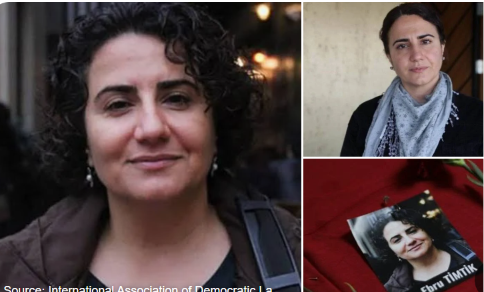
Að ofan: Myndir af Ebru Timtik
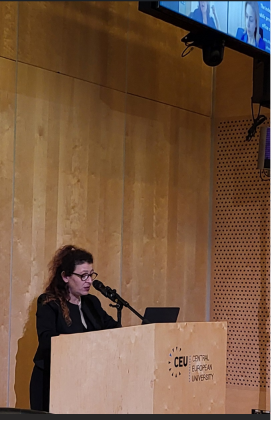
Að neðan: Ceren Uyusal sem hafði yfirumsjón með ráðastefnunni og setti hana.
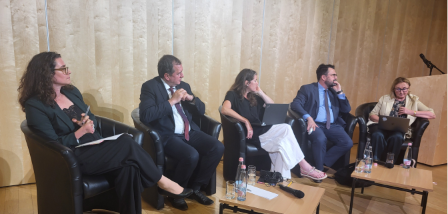
Fram fóru panelumræður á ráðstefnunni. Að ofan er mynd af einum slíkum fundi þar sem fulltrúar réttarkefis og maaréttindastofnanna ræddust við.
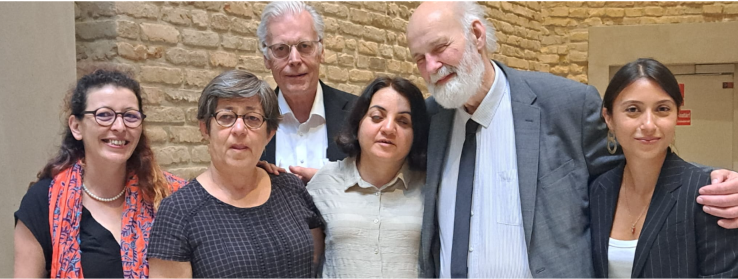
Að neða nokkrar svipmyndir. 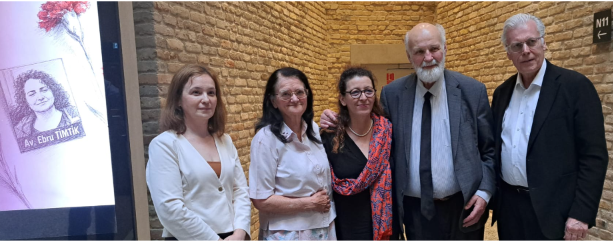
--------------
Athygli er vakin á því að hægt er að gerast áskrifandi að fréttabréfi þessarar heimasíðu á slóð sem hér er að finna: https://www.ogmundur.is/
Fréttabréfið er sent aðeins endrum og eins til áskrifenda þeim að kostnaðarlausu að sjálfsögðu.
Here you can subscribe to a newsletter from this homepage, free of charge of course: https://www.ogmundur.is/
(Ábending: Margir þeirra sem hafa viljað skrá sig á útsendingarlista fréttabréfsins hafa orðið fyrir því að fá ekkert viðbragð eftir skráningu. Skýringin hefur oftar en ekki verið sú pósturinn hefur hafnað í ruslpósti. Fólk gæti að þessu.
To be taken note of: Sometimes people who have wanted to subscribe to the news-letter (by pressing skrá netfang and by then giving their e-mail, netfangið þitt) have not got any confirmation. Usually this is because the reply has been directed to the trash bin. Be aware of this.)