
SARAH GLYNN: KURDISH PEACE – A PARTNER MISSING
Stundum hef ég birt pistla Söruh Glynn hér á síðunni en hún starfar í Strassborg með stjórnmálahreyfingu Kúrda á þingi Evrópuráðsins.
Í pistlum sínum greinir hún stöðu Kúrda í Tyrklandi, Sýrlandi, Íran og Írak. Hún hefur einstakt lag á því að koma mörgu til skila í fáum orðum. Og orðum sínum kemur hún á framfæri bæði í töluðu og rituðu máli.
Í nýjustu pistlum Söruh frá því í sumar og í haust sem ég hef birt hefur hún fylgt eftir “aðlögunarviðræðum” Kúrda við nýju stjórnina í Damaskus í Sýrlandi sem Vesturveldin og Ísrael komu a laggirnar þegar þeim loksins tókst að bola Assad forseta Sýrlands frá völdum í lok árs 2024 eftir blóðugt stríð í rúmlega hálfan annan áratug.
Nýju valdhafarnir í Damaskus eru harðlínu íslamskir trúmenn sem fáir hefðu trúað að vestræn ríki hefðu stutt til valda eftir að þau höfðu skilgreint þá sem stórvarasama hryðjuverkamenn.
Vesturveldin eru að vissu leyti komin í hring. Þannig hófst aðförin að Assad stjórninni sýrlensku með vestrænum stuðningi við þessi íslömsku harðlínuöfl. Uppstytta varð hins vegar þegar Íslamistum fór að takast að ná hinum miklu olíuauðlindum á þessum slóðum undir sín yfirráð. Þá þótti ástæða til að kveða þá niður og er Kúrdum einkum þakkað að það skuli hafa tekist. Þegar Íslamistar hafa nú aftur á móti vent sínu kvæði í kross og gerst kapítalismanum handgengnir og opnað fyrir vestrænar fjárfestingar er komin upp draumastaða fyrir BNA og NATÓ ríkin. Þetta skýrir stuðning þeirra við hryðjuverkamanninn al-Jolani, sem nú gengst við eiginlegu nafni sínu, al-Sharaa, æðsta ráðamanni í Sýrlandi.
Það þarf ekki að undrast það að Kúrdum í Rojava, sem á undanförnum árum hafa nýtt sjálfstjórn sína til þess að þróa lýðræðislega stjórnskipan með áherslu á jafnrétti kynjanna, gangi illa að "aðlagast" á forsendum þessara nýju herra.
Í pistlum sínum hefur Sarah Glynn ekki verið bjartsýn fyrir hönd Kúrda í fyrrum sjálfstjórnarhéraði þeirra I Sýrlandi, Rojava, en bendir á að Kúrdar hafi ekki átt margra kosta völ eftir að Bandaríkin og Evrópuríkin sáu sér ekki lengur hag í að veita Kúrdum stuðning – þótt takmarkaður væri – og aldrei svo mikinn að þeir gætu ógnað NATÓ vininum Tyrklandi.
Í þessum pistli sem hér birtist byggir Sarah Glynn á mati tveggja kvenna sem hafa verið leiðandi í hreyfingu Kúrda í Rojava, annars vegar Ilham Ahmed sem var helsta talskona sjálfstjórnarhéraðsins Rojava í utanríkismálum og Besê Hozat, sem átti sæti í æðstu stjórn Kúrdíska verkamannaflokksins, PKK, sem nú hefur verið leystur upp af hálfu Kúrda sjálfra til þess að sýna í verki friðarvilja sinn.
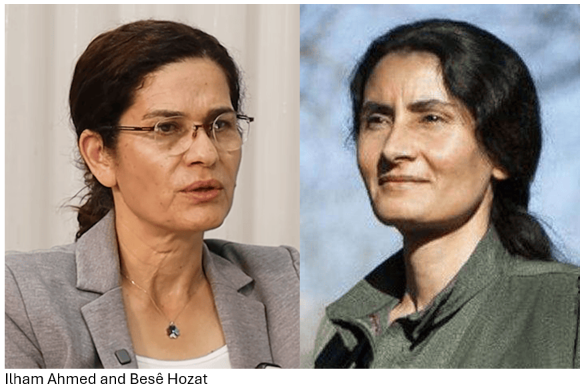
"When I began this blog, my aim was to share important developments impacting the Kurds, but today I will focus on an absence of developments that should be a major cause for concern for anyone worried about Kurdish futures, or about the Middle East more generally. I will do this through the comments of two remarkable Kurdish women, Ilham Ahmed, who was the de facto foreign ambassador for Rojava, and has now gone to Damascus to work with the Syrian government, and Besê Hozat, Co-chair of the Kurdistan Communities Union and member of the (technically dissolved) PKK’s General Presidential Council.
Turkish influence in Syria ensures that the situation there is inseparable from the peace process in Turkey."
Hér má hlusta á pistil Söruh Glynn og lesa hann einnig.
Here you can read and listen to Sarah Glynn reporting on the „integration process“ in Syria. It is not an optimistic report but I have a feeling it is realistic:
https://newsfromkurdistan.wordpress.com/2026/10/20/kurdish-peace-still-missing-a-committed-partner/
The struggle to maintain gains in Rojava
As a politician, Ilham Ahmed always looks for paths towards a better future, but when she spoke at last week’s EU Turkey Civic Commission (EUTCC) conference in the European Parliament, her analysis of the circumstances in Syria was sobering.
While noting that integration of the Syrian Democratic Forces into the Syrian national army is now 95% complete, and integration of the internal security forces (Asayish) 75% complete, she repeatedly underlined the absence of any constitutional framework to guarantee any of the agreements that have been achieved and to make peace permanent.
She spoke of government sectarianism that reproduces Arab chauvinism, isolates the Alawites, acts against Kurds and other minorities, and ensures that the greater part of Syrian society is not a partner in the new administration. She explained that they were still arguing for the right to mother-tongue education. And she observed that in Kobanê – the city that became the symbol of Kurdish resistance against ISIS – people who left when it was under attack are claiming government positions in place of Kobanê’s long-standing defenders who built up its administration.
With regard to the position of women, she explained that they had expected that women would be able to change the whole of Syrian society as they had in the Autonomous Administration, but that, instead, they were having to struggle to maintain their existing gains in Rojava. The new Syrian government is regressive when it comes to women’s rights, and makes all decisions centrally. They don’t allow the system of male and female co-chairs practised by the Autonomous Administration, so the Kurds have resorted to choosing women as heads of institutions to ensure the continuation of women’s influence.
For Ilham Ahmed, “peace” without the participation of women, is not a genuine peace. She stated that Kurds are ready to be genuine partners in the new Syria, but need recognition, respect and trust, positions in official bodies and government, and the safeguard of a constitution; and that along with women’s rights, these would form real steps towards democratisation.
For now though, as was clear from her description, these steps are long way off.
Government inaction wears down hopes of Kurdish-Turkish peace
The struggle for democracy is also central to the peace process in Turkey, which has become bogged down in government inaction. Besê Hozat’s recent interview with Tugce Tatari for T24 gives us the view from Qandil – the PKK’s base in the mountains of the Kurdistan Region of Iraq.
Fundamental problems overwhelm even the mechanics of this process. Hozat explained,
We have communication with İmralı [Island Prison] and Leader Apo [Abdullah Öcalan]. However, there are sometimes restrictions, and sometimes meetings don’t happen for weeks. The results of the meetings held by the DEM Party delegation are also reflected to us. There is also a mechanism that serves as a liaison between us and our leader.
The letters we write, our various opinions, reach our leader through this mechanism. We receive letters and opinions from our leader. In addition to this DEM Party delegation, there is also a separate mechanism between us and our leader.
In fact, we should also go and hold meetings. The fact that this hasn’t happened is already a shortcoming. We have always demanded this, always wanted this. If Leader Apo is to conduct this process freely, he needs to have a direct relationship with the movement.
That Öcalan be free to meet both with his organisation and with others has always been top and centre of the PKK’s demands. These meetings would include journalists to make the process transparent to the public. The demand is vital in a practical sense, but also more than that. As Hozat put it, “Leader Apo is the Kurdish identity… Leader Apo’s freedom is the acceptance of Kurdish identity.” And she made clear that the PKK “consider[s] all approaches to solutions without a leader as impositions of surrender.” She insists that Öcalan’s freedom to work must be given legal status so that it cannot be withdrawn at the whim of the state.
In her criticism of the Framework Law, passed by the Turkish parliament on 10 August, Hozat claims that the law as it stands will not solve any problems. It is intended to provide a mechanism for PKK guerrillas to return to civilian life in Turkey, but she observes,
While they don’t implement the decisions of the Constitutional Court, while they don’t implement the decisions of the European Court of Human Rights, while they don’t even implement their own laws, who, which guerrilla, will trust enough to go to Turkey and say; ‘I will go and engage in democratic politics, they will offer me the opportunity to do so’?
She insists that the ability to return to civilian life must be applied to everyone, including senior PKK cadres and Öcalan himself, that it must include freedom to engage in politics, and that the process must evolve into a general democratisation of Turkey and the recognition of local democracy. And she recalls Öcalan’s initial call from 27 February 2025, when he said, “Give me the opportunity, and I can shift this issue from the ground of violence to the ground of politics and law.”
Hozat does not spare the mainstream opposition (now split into the Republican People’s Party (CHP) and the Yeni Party), which is undergoing a debilitating attack from Recep Tayyip Erdoğan’s politicised judiciary. She accuses them of being unable to “break away from the state’s century-old codes,” and claims that in their failure to strongly embrace the peace process and “transcend the boundaries set by the government,” they have brought harm on themselves as well as on Turkey.
She reminds us that even left movements have kept their distance from the Kurdish struggle, but that that struggle is integral to the democratisation of Turkey.
Hozat states that the PKK has withdrawn every guerrilla from Turkey and also vacated their tunnels closest to the Turkish border, but that the Turkish government “seems to be playing for time”. She suggests that they are weighing up the situation in the region – i.e. the changing power balance as Israel and the United States attempt to redesign the Middle East – and that the government could also attempt to instrumentalise the process for the presidential elections, to the detriment of the Turkish people.
Hozat makes clear that without more movement from the state, “no further steps should be expected from us.” In her analysis, the first thing that the state needs to do is give Öcalan the necessary freedom to conduct the peace process, and the “fundamental condition” for the return of the guerrillas is democratisation.
Turkey’s slide into fascism
But, far from democratising, Turkey is becoming even more authoritarian. Two weeks earlier, T24 – which carried the interview with Hozat – saw their website blocked in Turkey with the claim that they had published articles that constituted “LGBT propaganda”, part of a major crackdown on LGBT activists and defenders of human rights.
On 14 October, opposition-supporting Halk TV, Turkey’s most watched news channel, was taken over by the government mid live broadcast. Nacho Sànchez Amor, the EU’s Rapporteur on Turkey, commented on Twitter,
Not happy with controlling 90% of media, Turkish authorities are aiming for the 100%. After Tele1, now is the turn of @halktvcomtr where they also installed a kayyum [trustee]. Amidst detentions of journalists & broad online censorship, freedom of media & expression will soon be just a memory.
Halk TV’s owner, Cafer Mahiroğlu, claimed that this takeover was aimed at diverting attention from an eighteen-billion-dollar financial scandal that has implicated senior members of Erdoğan’s Justice and Development Party (AKP) and robbed hundreds of thousands of investors of their savings.
Meanwhile, the state authorities have been continuing their pressure on the mainstream opposition, which they have already succeeded in splitting into two. Elected opposition mayors who don’t want to be deposed, and possibly imprisoned, under accusations of corruption, and want to be on the side of power, are given the opportunity to change allegiance and join the ruling AKP, and over seventy-five have chosen to defy their electors and save their positions. On 7 October they were joined by the mayor of Izmir, Turkey’s third largest city, which he had won for the CHP with 49% of the vote compared to 37% for the AKP.
It is difficult to find many grounds for optimism in all this, either for the peace process or for Turkey as a whole – and of course both are inextricably linked. The future is being sacrificed for short term power politics. Having destroyed the opposition, Erdoğan is preparing for an early election that would allow him to compete for a third presidential term, and he may demand DEM Party support to enable him to end his current term before it runs its full course. He continues to portray what should be a peace process simply as ending terrorism. There will also be elements of the Turkish state who are determined to deny any concessions to Öcalan, and who welcome any Kurdish concerns about the path that Öcalan has decided on. But in their search for victory rather than dialogue, they risk throwing away a unique opportunity to heal a gaping wound in Turkey’s society and create a genuinely unified country.
And back to Europe
I began with the EUTCC conference, and I want to finish with a brief look at possible European actions. As the conference noted, the European Union continues to maintain good relations with Turkey, even while denying EU membership, and continues to keep the PKK on their terrorist list despite the movement’s commitment to peace. Gaza continues to expose the hypocrisy of European statements on human rights, and European governments are increasingly providing models of authoritarianism rather than effective critiques. However, there is still the possibility of international action in support of the peace process. Lifting the ban on the PKK would send a powerful message.
Next door, at the Council of Europe, more could be done to put pressure on Turkey to comply with the rulings of the European Court of Human Rights, in line with Turkey’s own law and treaty obligations. Turkey threatens to leave the Council if they don’t get their own way – an action that no one wants, including Turkey themselves – but every time the institution fails to follow up on court judgements, the court loses legitimacy.
The situation in Syria is a product of Turkish intervention, but also of the intervention of Western powers, who chose to back (now President) al-Sharaa and welcome him into the neoliberal fold. Now, al-Sharaa is relying on foreign investment to rebuild his shattered country, and it is not in the interest of these foreign investors for Syria to collapse into violence and uncertainty. However, if they want to encourage stability, they first need to move away from the propaganda of Syrian success and understand the country’s dangerous interactive cocktail of political, social and economic problems.
Noone said politics was easy, and building peace must be the hardest politics of all. On Thursday, it will be two years since the far-right nationalist leader, Devlet Bahçeli – Erdoğan’s partner in government – called for Öcalan to come to the Turkish Parliament and demand the disbanding of the PKK. Thanks to Öcalan, the PKK has now officially dissolved itself, but there has been no indication that Öcalan will be allowed to speak in parliament or be allowed his Right to Hope – the possibility of parole – which Bahçeli also suggested.
Sarah Glynn
Strasbourg 20 October 2026
Á eftirfarandi slóð má komast inn á síðu með safni undangenginna greina.
Here you can approach earlier reports:
https://newsfromkurdistan.wordpress.com/
--------
Athygli er vakin á því að hægt er að gerast áskrifandi að fréttabréfi þessarar heimasíðu á slóð sem hér er að finna: https://www.ogmundur.is/
Fréttabréfið er sent aðeins endrum og eins til áskrifenda þeim að kostnaðarlausu að sjálfsögðu.
Here you can subscribe to a newsletter from this homepage, free of charge of course: https://www.ogmundur.is/
(Ábending: Margir þeirra sem hafa viljað skrá sig á útsendingarlista fréttabréfsins hafa orðið fyrir því að fá ekkert viðbragð eftir skráningu. Skýringin hefur oftar en ekki verið sú pósturinn hefur hafnað í ruslpósti. Fólk gæti að þessu.
To be taken note of: Sometimes people who have wanted to subscribe to the news-letter (by pressing skrá netfang and by then giving their e-mail, netfangið þitt) have not got any confirmation. Usually this is because the reply has been directed to the trash bin. Be aware of this.)